Spring Reverberator

anchor Get Twangström

69 €

Bundle options

Download for Windows

Also available for: macOS, Linux

anchor Twangström in the spotlight!

A flexible spring reverb box-of-tricks. If you’re familiar with Bazille, you might already have come across its built-in spring unit. We took that one, then modelled two more reverb tanks, paired it with drive section, filter stage, envelope, and mod matrix. It emulates a hand-picked selection of the most popular units you will find in classic guitar and instrument amplifiers, recreating the odd character of real springs.

a screenshot of Twangström’s user interface

Hover over the dots Dot to learn about Twangström’s features

- shakeable springs - 3 different reverberation tanks, inspired by the most popular ones built in the guitar & instrument amps that made rock ’n’ roll - tasty drive & tone stage for heating-up and colouring the sound - multi-mode filter, with variable type blend
- four-flavours envelope stage, picking up the signal from either input, output or external sidechain - LFO module, 8 different types & waveforms, variable time base & syncable - comprehensive modulation matrix, for realtime control of all the parameters - independent input and feedback routing options allow all possible stereo or mono combinations
- 76 factory presets, NKS-compatible - UI instantly resizable from 50% to 200% - custom remote control via MIDI CC, 14-bit resolution option

Sights and sounds

  • Dry/Wet Audio

  • Screenshots

DRY’; $PLAYER_INFO = ‘’; $PLAYER_URL = ‘https://media.u-he.com/twangstrom/dry-wet-demos/twangstrom_basic3springs_rhythm_dry.mp3'; ?>

WET’; $PLAYER_INFO = ‘Preset used: Basic 3 Springs

Tweaked version of the type-8 tank preset with enabled Bright mode and slightly shorter decay time.

Created by Sascha.’; $PLAYER_URL = ‘https://media.u-he.com/twangstrom/dry-wet-demos/twangstrom_basic3springs_rhythm_wet.mp3'; ?>

DRY’; $PLAYER_INFO = ‘’; $PLAYER_URL = ‘https://media.u-he.com/twangstrom/dry-wet-demos/twangstrom_plate4_e-guitar_dry.mp3'; ?>

WET’; $PLAYER_INFO = ‘Preset used: Plate #4

Simple “vanilla” reverb settings, but LFO and input volume have a subtle effect on the behaviour of the spring, adding some liveliness.

Created by Rob.’; $PLAYER_URL = ‘https://media.u-he.com/twangstrom/dry-wet-demos/twangstrom_plate4_e-guitar_wet.mp3'; ?>

DRY’; $PLAYER_INFO = ‘’; $PLAYER_URL = ‘https://media.u-he.com/twangstrom/dry-wet-demos/twangstrom_floatingpoint_rhodes_dry.mp3'; ?>

WET’; $PLAYER_INFO = ‘Preset used: Floating Point

Small amounts of overdrive and subtle high-pass filter movement give the long reverb decay some colour and movement.

Created by Viktor.’; $PLAYER_URL = ‘https://media.u-he.com/twangstrom/dry-wet-demos/twangstrom_floatingpoint_rhodes_wet.mp3'; ?>

DRY’; $PLAYER_INFO = ‘’; $PLAYER_URL = ‘https://media.u-he.com/twangstrom/dry-wet-demos/twangstrom_basic2springs_arpeggio_dry.mp3'; ?>

WET’; $PLAYER_INFO = ‘Preset used: Basic 2 Springs

Adjusted in Decay & with engaged Bright mode, the result nicely mimics a typical combo-based large-sized reverb tank.

Created by Sascha.’; $PLAYER_URL = ‘https://media.u-he.com/twangstrom/dry-wet-demos/twangstrom_basic2springs_arpeggio_wet.mp3'; ?>

DRY’; $PLAYER_INFO = ‘’; $PLAYER_URL = ‘https://media.u-he.com/twangstrom/dry-wet-demos/twangstrom_stanleystutters_a-guitar_dry.mp3'; ?>

WET’; $PLAYER_INFO = ‘Preset used: Stanley Stutters

Apart from the denser reverb tail, this uses a dynamic tremolo on the input signal - louder signal, stronger tremolo.

Created by Rob.’; $PLAYER_URL = ‘https://media.u-he.com/twangstrom/dry-wet-demos/twangstrom_stanleystutters_a-guitar_wet.mp3'; ?>

DRY’; $PLAYER_INFO = ‘’; $PLAYER_URL = ‘https://media.u-he.com/twangstrom/dry-wet-demos/twangstrom_suspensionbridge_e-guitar_dry.mp3'; ?>

WET’; $PLAYER_INFO = ‘Preset used: Suspension Bridge

Small amounts of overdrive add some grit to the reverb tail, whose wobbly movement comes from the low spring tension setting.

Created by Viktor.’; $PLAYER_URL = ‘https://media.u-he.com/twangstrom/dry-wet-demos/twangstrom_suspensionbridge_e-guitar_wet.mp3'; ?>

DRY’; $PLAYER_INFO = ‘’; $PLAYER_URL = ‘https://media.u-he.com/twangstrom/dry-wet-demos/twangstrom_touchoftwang_e-guitar_dry.mp3'; ?>

WET’; $PLAYER_INFO = ‘Preset used: Touch of Twang

Classic 60s-style guitar, classic 60s-style spring reverb setting.

Created by Rob.’; $PLAYER_URL = ‘https://media.u-he.com/twangstrom/dry-wet-demos/twangstrom_touchoftwang_e-guitar_wet.mp3'; ?>

DRY’; $PLAYER_INFO = ‘’; $PLAYER_URL = ‘https://media.u-he.com/twangstrom/dry-wet-demos/twangstrom_wahscreamer_rhodes_dry.mp3'; ?>

WET’; $PLAYER_INFO = ‘Preset used: Wah Screamer

Auto-wah setting where the envelope follower moves the filter to add some funky bite to the electric piano. Very short reverb settings give the impression of a small practise room.

Created by Viktor.’; $PLAYER_URL = ‘https://media.u-he.com/twangstrom/dry-wet-demos/twangstrom_wahscreamer_rhodes_wet.mp3'; ?>

As a faithful emulation of a mechanical device, Twangström needs to be handled well. Many of the technical parameters are user-adjustable in real time, and these can be controlled via MIDI or using the internal LFO and envelope generator. With its multimode resonant filter, Twangström is a unique and powerful tool which can deliver highly unusual, evolving textures … especially when the signal is tossed around using the modulation matrix!
Spring? What’s that?

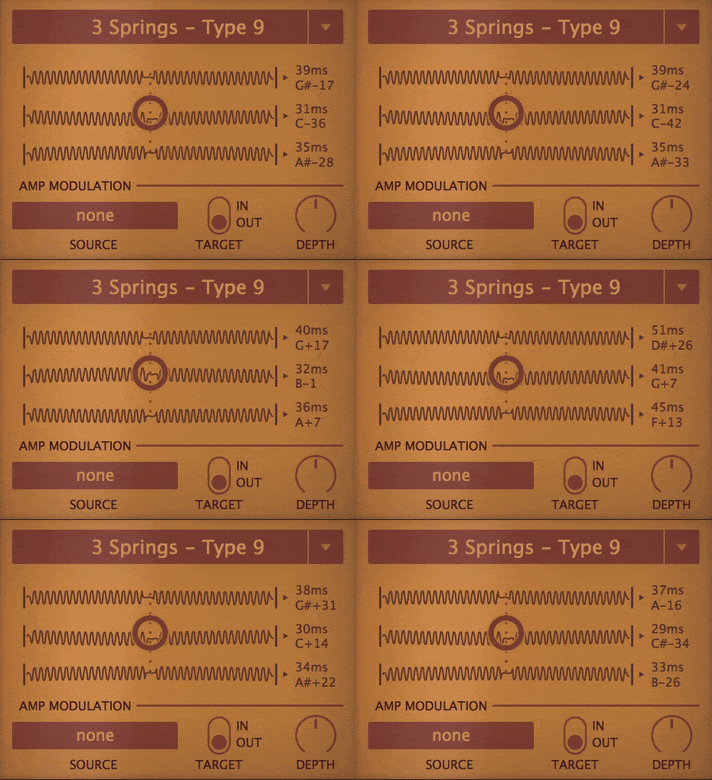
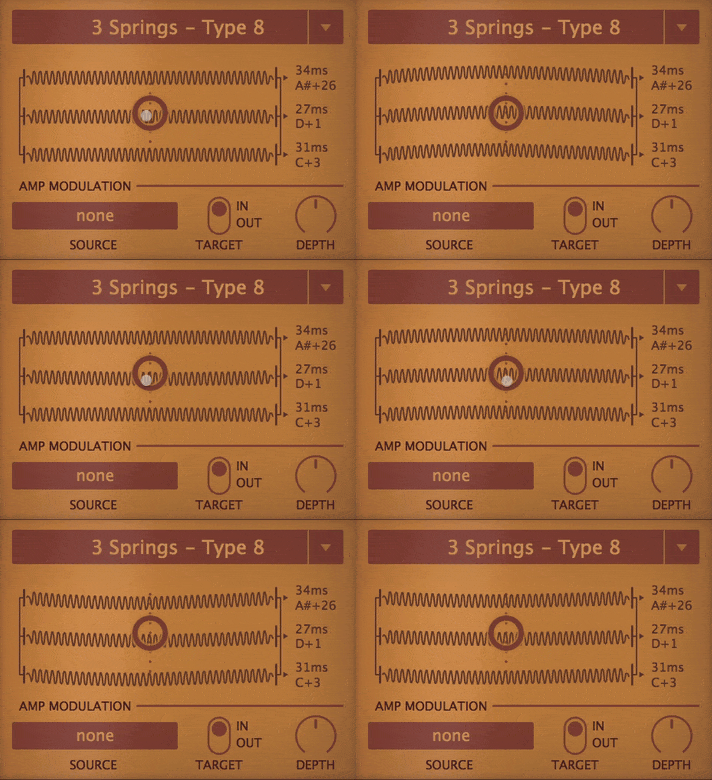
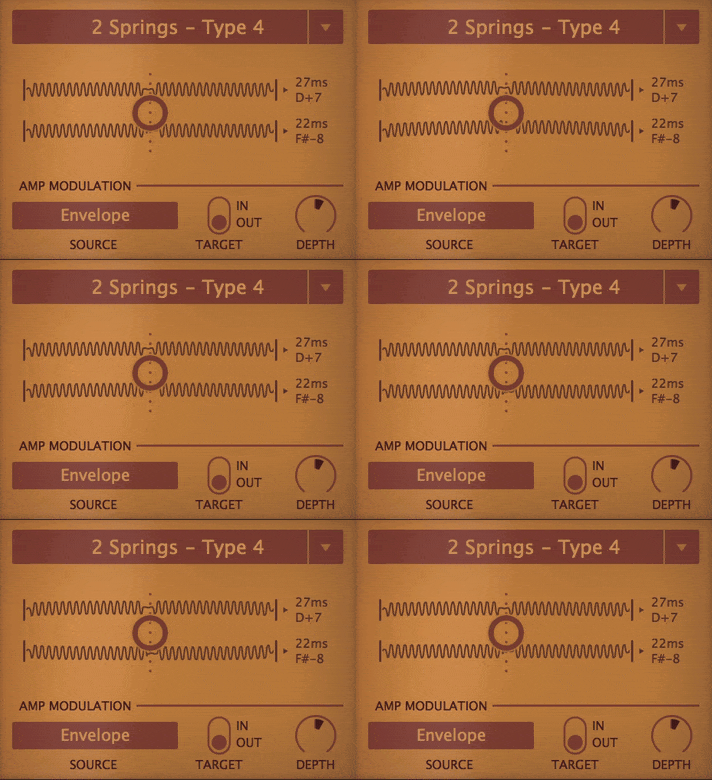
Shakeable springs

![Shakeable springs - 1](/products/twangstrom/assets/images/shake-anim-1.gif)
![Shakeable springs - 1](/products/twangstrom/assets/images/shake-anim-2.gif)
![Shakeable springs - 1](/products/twangstrom/assets/images/shake-anim-3.gif)
Hitting your computer won’t make Twangström shatter, so we added a *twang* control. This is used to shake the springs, either manually or through modulation and automation. You might think this is a gimmick for which you have no further use (apart from waking up the neighbours), but if you modulate it slightly, everything comes to life!
Tank controls ---------------

Twangström’s reverb is based on physical modelling. As opposed to plug-ins based on impulse responses (IR), our approach mimics the physics of mechanical reverberation. By simulating the wavefront travelling through a medium, we can include all the aspects of excitation, reflection, dispersion, interference, and other audio properties. Twangström does not mimic the sonic result, but simulates the physical device. This means that all dimensions of the device are controllable in realtime, on a per-sample-basis – which all boils down to quite some power at your fingertips!

![Twangström - Tank Controls](/products/twangstrom/assets/images/tank-controls.png) Tank Controls in Twangström’s UI
Envelope ----------

The envelope in Twangström features 4 different modes and can pick up the signal from either input, output or external sidechain. You can select between Envelope Follower, Attack and Decay, Attack and Release, or Cyclic modes. The last one is similar to a 2-stage LFO. Shown controls will adapt to the selected mode, with Threshold not appearing while in Envelope Follower mode.

![Twangström - Envelope](/products/twangstrom/assets/images/envelope.jpg) Envelope in Twangström’s UI
Modulation Matrix -------------------

The modulation matrix has three general purpose modulation slots, and yes, you can select shake as one of many targets to modulate the Twang control!

![Twangström - Modulation Matrix](/products/twangstrom/assets/images/modulation-matrix.jpg) Modulation Matrix in Twangström’s UI
Low Frequency Oscillator --------------------------

The LFO features different time bases, including a non-synchronized one measured in seconds. Synchronized options include both dotted times and triplets. There are 8 different waveforms to choose from, with 2 of them being stepped or glide random shapes.

![Twangström - LFO](/products/twangstrom/assets/images/lfo.jpg) LFO in Twangström’s UI

anchor Releases

anchor 1.0.2

CLAP and AAX

published
revision
16742

Fixed bugs

  • Fixed: VST3 crashes in Digital Performer related to plugin GUI

  • Fixed: dialogues could appear behind plugin GUI in Cubase (Windows only)

  • Fixed: Windows UI scaling was messing with dialogue positioning

  • Fixed: using CMD+A in dialogues made the GUI disappear in Logic

  • Fixed: aborted preset save operation could lead to wrong metadata being displayed in the inspector

  • Fixed: using the “duplicate” option in the browser could crash if permissions were missing

Read more …

anchor

Version 1.0.2 (rev. 16742) – Released October 15, 2024
Release notes

69 €

Bundle options

Download for Windows

Also available for: macOS, Linux

Please be aware the Linux versions of our plug-ins are still considered beta. While the plug-ins are stable, we are not able to provide the same level of support for these products as we do for the macOS and Windows versions. Support is provided via the Linux and u-he communities on our forum.

System

  • macOS macOS (10.10 or newer)

  • Windows Windows (7 or newer)

  • Linux Linux (glibc version 2.28 or newer)

  • 30–90 MB free disk space
  • 1000 × 600 pixel or larger display

CPU

  • Mac: Intel Nehalem, Apple M1 or newer
  • Windows/Linux: Intel Nehalem, AMD Bulldozer

Formats*

  • Windows (32-bit): VST3
  • Windows (64-bit): CLAP, VST3, AAX**
  • macOS (64-bit): CLAP, AUv2, VST3, AAX**
  • Linux (64-bit): CLAP, VST3

* This plug-in requires host software (DAW)

** AAX requires Pro Tools 10.3.7 or newer

Downloads