Bazille is a large modular system combining digital oscillators with analogue-style filters and modelled effects, with a flexibility that only modular patching can provide. After [ACE](/products/ace/), the second spawn of our ongoing Berlin Modular project, this one is a very different, much larger beast …
Those in the know have been waiting for this since 2009.
Read Urs’ own story
Berlin Modular
--------------
“About four years ago I started to work on a new synthesizer. The idea was to build a virtual modular system much like the first modular system I ever used in 1986—an old and hilariously out of tune Roland System 100M. I totally loved that thing. It stood in a room in my grammar school, and I spent hours and hours patching it up.
“Over the last couple of years I built a little modular synth based on Doepfer’s Eurorack modules. It has become a nice and inspiring hobby, but it’s also quite expensive and for me (as a software user) really difficult to work with. I’m used to being able to save patches, I’m used to having multiple instances of my synth, and I’m used to play chords. All these things are simply non-existant in an analogue modular system. On the other hand you have that tactile thing with the hands-on experience. Plugging cables, turning real knobs and all that is very rewarding compared to just pushing a mouse.
“Nevertheless, I have always kept the idea of a software modular system in the back of my mind. Recently some other ideas somehow nicely aligned with that concept, and the Berlin Modular project experienced a massive boost in pace!
“Of course the name Berlin Modular is meant to be reminiscent of the Berlin School of electronic music, and expecially of the bands and artists I listened to when I was a teenager. Those guys e.g. Tangerine Dream and Jean-Michel Jarre inspired me to make electronic music my hobby, and in the end they also inspired me to develop synthesizers. So what could be more obvious than dedicating a synth to their style?
“The idea is easily explained: Imagine you have a modular system in a rackmount enclosure with a couple of oscillators, a couple of filters and envelopes. Now imagine you have three or four of these systems with different types of modules. That’s the basic concept: Similar systems based on different modules. They are already nicely put together and ready to make some noise!
“A while ago I demonstrated a prototype of the first system within Berlin Modular. I call it Bazille, which is German for bacterium. It has become quite a crazy fellow! Bazille combines 4-oscillator FM-synthesis and Phase Distortion with the depth and flexibility of modular patching …”
Features
Ultraflexible modules
---------------------
Bazille is highly unusual for a modular synth.
Although the filters are traditional analogue models, the oscillators are unashamedly digital: They combine the two technologies that made digital synthesis affordable (and analogue synths suddenly unfashionable) in the
1980s – FM (frequency modulation, more correctly ‘phase modulation’) and PD (phase distortion).
In Bazille, each oscillator panel has five distinct sections:
Pitch, Phase / FM, Phase Distortion, Fractal Resonance, and the Outputs, each with a modulation input.
Since the 4 main oscillators have a frequency range which starts at zero Hertz, they can be used as synchronized or unsynchronized LFOs or also adopt custom shapes thanks to Bazille’s mapping generators. The oscillators are also capable of all kinds of FM sounds by plugging an audio-frequency source into the phase modulation input.
One of the most interesting features included in Bazille’s powerful oscillators is an unusual process we call Fractalize (fractal resonance). This can be used to create very bold sounds from tame waveforms, with a similar result to the classic cutting sound of the sync effect.
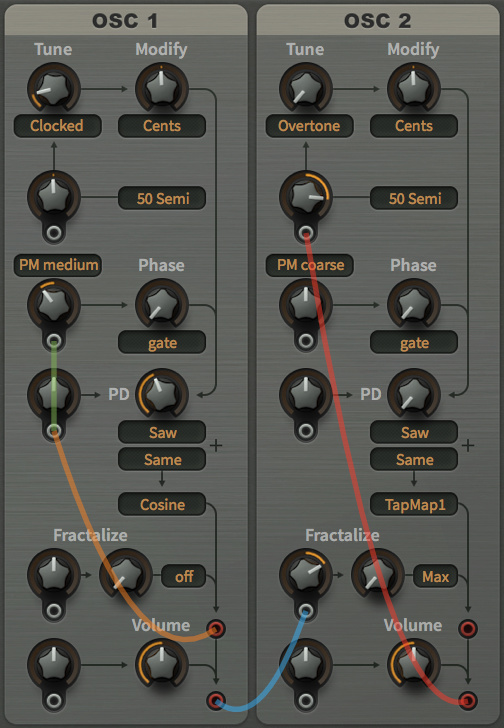2 of Bazille’s oscillators
Mapping generators
------------------
The pair of Mapping Generators can be used for a variety of purposes: To reshape modulation sources, to define per-MIDI-note offsets or to step through values e.g. for round-robin effects … There are 4 modes available, and both generators can have maps with up to 128 steps. They are very flexible, allowing custom shapes thanks to the drawing tools and presets accessible with a right-click of the mouse.
Mapping generators
Multiplex
---------
The little multiple" modules you can find in most analogue modular systems are simple mix/split devices. As Bazille’s output sockets can accommodate several cables, the humble multiple underwent a serious redesign, emerging as something so flexible that we had to rename it Multiplex. The 4 units are very “general-purpose”: They can be used as signal mixers, cross faders, ring modulators, amplitude modulators, and more …
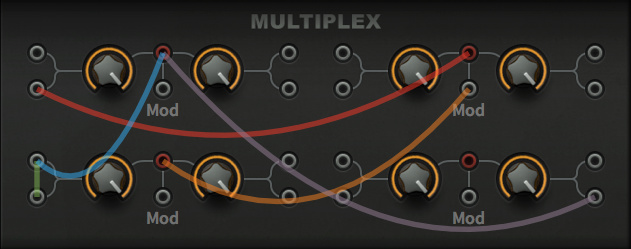Multiplex section
Modulation sequencer
--------------------
The onboard modulation sequencer lets you set up much more complex movements than are available with a regular LFO. It can be divided into 2, 3 or 4 sections, two of which can also be used as a per-voice note sequencers (steps can trigger envelopes). Also present is a modulatable Rotate control, which lets you morph between up to 8 different sequences.
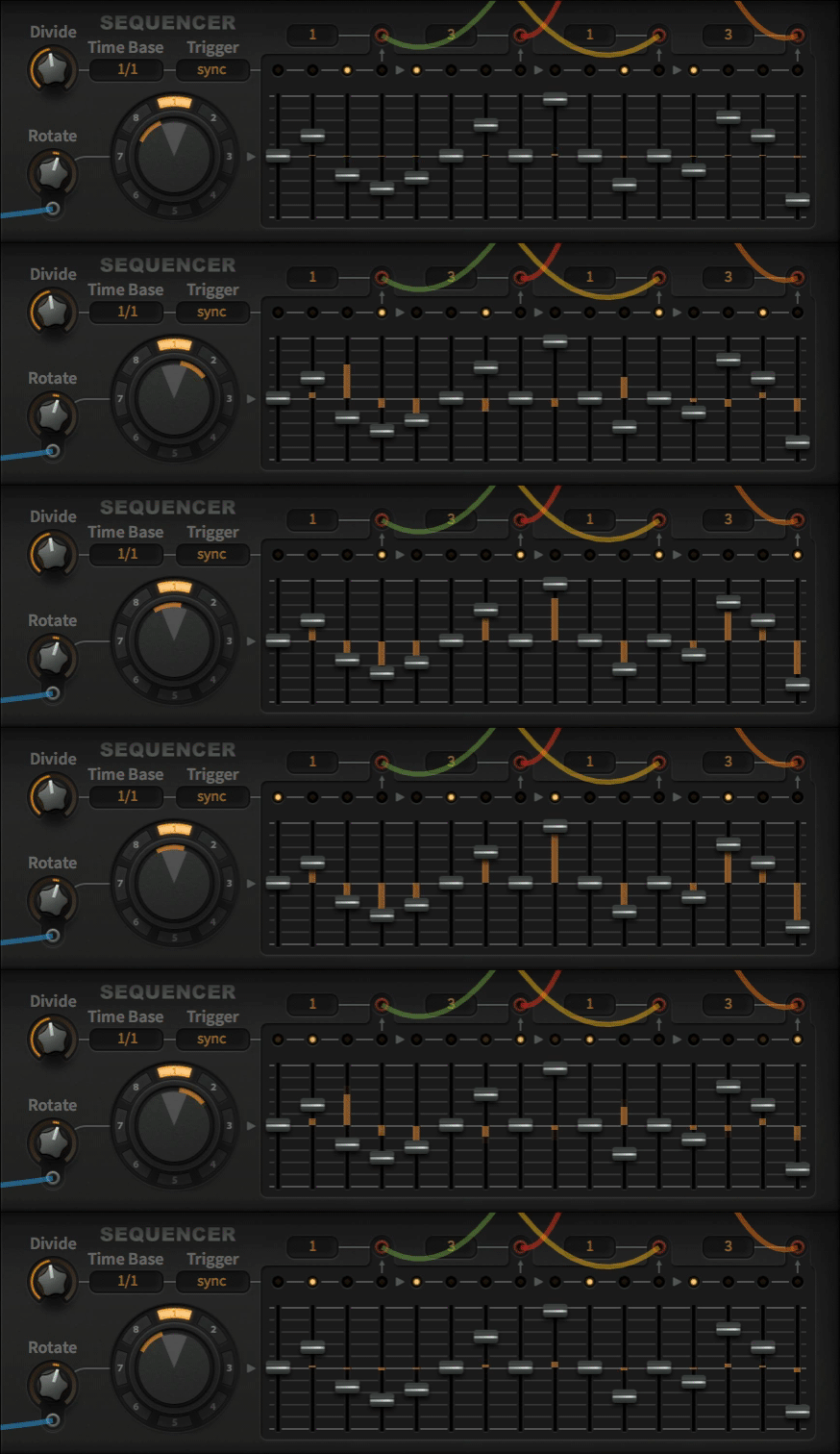Modulation sequencer

 ’; $PLAYER_URL = ‘

