Get Wiretap
149 €
Wiretap in the spotlight!
Patch Wiretap between any pitch CV source and its destination. Wiretap will track that CV and send a new gate or pulse whenever it detects a significant change in voltage.
You can use these gates / pulses to trigger envelopes or drum voices, drive sequencers, reset LFOs, to name but a few possibilities. Melodies are transformed into rhythms, making Wiretap an ideal companion to sequencers that don’t have a gate output, or as a core component of generative composition projects. It is also the perfect partner for our CVilization utility module!
Wiretap tracks any CV you care to send it while you tweak the input signal’s controls, and creates appropriate triggers / gates in real time.
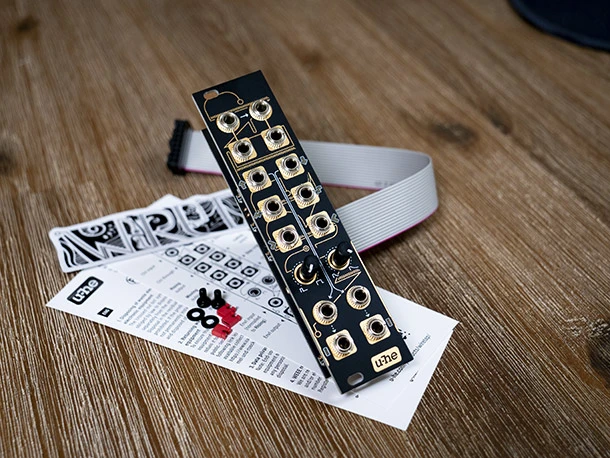
- Slope detection with 4 different outputs
- 2 input comparator outputs
- +/- 8V = 16 octaves input range
- The gate time is adjustable independently of detection logic
- 2 release envelopes / envelope followers
- Westcoast retrigger behaviour
- Jumpers for alternative behaviour
- “Hot” 7.5V envelope level
Sights and sounds
- Pictures
- Videos
Input Signals
You can use Wiretap to generate rhythmic patterns from all kinds of CV signals: LFOs, random voltages, sequences and even manually swept voltages. Or mix all of the above together and send the resulting signal through a quantizer. (See CVilization)
Two Channels
Wiretap features two channels, with separate inputs feeding a pair of slope detectors. Each channel has its own through-jack mirroring the unprocessed input CV, as well as three different gate / pulse outputs. With nothing connected to input 2, channel 2 is normalled to input 1 so that all six trigger outputs process input 1.
Six Individual Gate/Pulse Outputs
The six outputs provide triggers when the following conditions are met:
- Rising when the input CV starts to rise
- Falling when the input CV starts to fall
- Moving whenever there is a significant change (even gradual) in the input CV
- Step whenever the input CV jumps at least one semitone (1/12 Volt) up or down
- Higher whenever channel 1 input CV becomes greater than channel 2 input CV (or 0 Volt if input 2 is unplugged)
- Lower whenever channel 1 input CV drops below channel 2 input CV (or 0 Volt if input 1 is unplugged)
Wiretap vs other slope detectors
Regular slope detectors recognize motion or “states” - as rising, falling, moving, etc. - and set their gate outputs “high” according to the current state. As long as the voltage is rising, the rise gate is high. But if there is a voltage jump between two notes, which is common with sequencers and keyboards, a normal slope detector would only generate a very short gate.
Wiretap works differently, as it scans the incoming signal for changes in state or motion i.e. it triggers each time the signal starts to rise, fall, move or jump, and the Gate Time knob lets you adjust the gate length from short trigger pulses to longer gates independently of the incoming signal.
We consider this the more useful behaviour in most musical/rhythmic contexts. However, should you decide that your current patch could benefit from the classical slope detector behaviour, there is a jumper on the back of the module that can be set to such a “Hold Mode”.
Westcoast Retrigger Behaviour
The westcoast retrigger behaviour unlocks Wiretap’s clock divider powers to pep up straight beats.
Hold-Release-Envelopes
Wiretap’s two hold-release-envelopes are actually simple envelope followers with a very short attack and an adjustable release phase (which acts like a decay when pulsed). This means that the maximum level of the envelope is influenced by the input signal.
The envelopes can either be triggered by Wiretap’s gates (normalled to the Rising and Falling outputs) or from external sources patched into the envelope inputs. The envelopes hold the input level while the input is high, and decay to 0V when the gate goes low.
Jumpers
Two jumpers on the back of Wiretap will allow you to
- switch to a more traditional slope detector behaviour delivering continuous gates based on the current state instead of triggers on state changes
- have the module only trigger on events that happen in sync with a clock input to bring order to rhythmic chaos
Both jumper options can be combined to merge the two special modes.
149 €
Please be aware the Linux versions of our plug-ins are still considered beta. While the plug-ins are stable, we are not able to provide the same level of support for these products as we do for the macOS and Windows versions. Support is provided via the Linux and u-he communities on our forum.
System
macOS (10.10 or newer)
Windows (7 or newer)
Linux (glibc version 2.28 or newer)
- 50–125 MB free disk space
- 1000 × 600 pixel or larger display
CPU
- Mac: Intel Nehalem, Apple M1 or newer
- Windows/Linux: Intel Nehalem, AMD Bulldozer
Formats*
- Windows (32-bit): VST3
- Windows (64-bit): CLAP, VST3, AAX**
- macOS (64-bit): CLAP, AUv2, VST3, AAX**
- Linux (64-bit): CLAP, VST3
* This plug-in requires host software (DAW)
** AAX requires Pro Tools 10.3.7 or newer