Mix! Route! Mucord! Pan!

anchor Get CVilization

349 €

anchor CVilization in the spotlight!

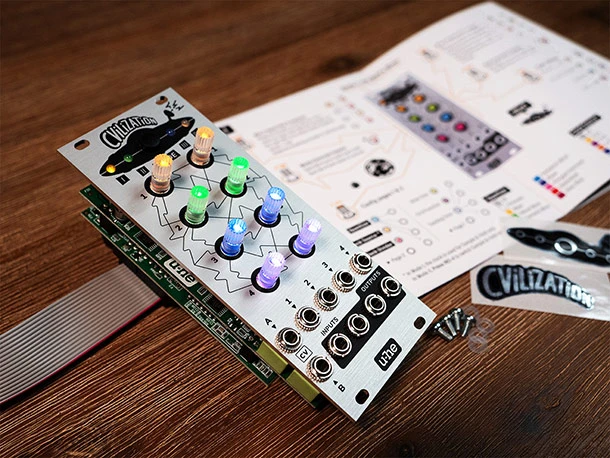
A compact Eurorack module featuring 4 operating modes that span a wide range of applications. While CVilization is perhaps not the most intuitive module in the world, it provides easy-to-learn solutions for many complex tasks. It can turn a small modular setup into an animated quadraphonic system. It can be your go-to quantizer or your preset-driven submixer. It can expand your step sequencer with extra tracks, randomisation and other performance features. CVilization has changed the way we approach modular composition.

a screenshot of CVilization’s user interface
- Mix: 4 x 4 matrix mixer with optional matrix rotation - Route: 4 x 4 sequential switch with 8 steps per output - Mucord: Quad ‘mucorder’ 4 tracks, 16 steps, realtime mutation - Pan: Quadraphonic panner with automatic and CV control
- Optional quantization, Sample & Hold, glide, CV control - Per mode: 7 user presets plus initialization preset - Up to 128 additional presets via Select Bus - 8 global user-defined scales (voltage quantization)

Sights and sounds

  • Pictures
  • Videos
4 x 4 Sequential Switch – Audio Signals
4 x 4 Sequential Switch – CV Signals
Quad Mucorder
Quadraphonic Panner
User scales
Matrix Rotation
More videos are underway, one or two for each mode. We recommend watching these videos as the first step in learning about CVilization. Even with just the overview video on top of this page and this in-depth video about Mode 1, it should be fairly easy to get into CVilization: The user interface is rather consistent across modes. Refer to the user guide (linked below) for more details, and keep the Ultimate Cheat Sheet handy for any colour coded options while you’re in the middle of something.

Subscribe to our YouTube channel Link to be notified as they come!

Modes in detail -----------------

4x4 Matrix Mixer

The Matrix Mixer mixes the 4 inputs (audio or CV) to the 4 outputs. This normally requires 16 gain knobs arranged in 4 rows and 4 columns, but CVilization’s rotary encoders with LED feedback let you easily do the same in a much smaller setup. With total recall and instantly accessible mutes for each input and output.

Each output of the Matrix Mixer can be transposed in octaves (+/- 10 Volt), semitones (+/- 24 steps of 1/12 Volt) and cents (+/- 100 steps of 1/1200 Volt), making the Matrix Mixer an ideal utility for V/oct signals e.g. tuning your oscillators - or wherever else you need precise voltage offsets.

You can further modify each mixer output with CVilization’s built-in quantizer, sample & hold and glide stages. At only 10HP and with a multitude of options, CVilization provides essential functionality without filling up your rack and requiring a dozen or more patch cords.

4x4 Sequential Switch

In the Sequential Switch mode a trigger signal shuffles the inputs (audio or CV) to the outputs. Each output has its own 8-step sequence which selects (per step) one of the inputs, a random value, a static value or a skip. Each step has its own gain control. This makes CVilization not only a highly flexible buffered sequential switch, but it also acts as a 4-way CV-sequencer - with optional quantisation, sample & hold and glide.

Imagine having four rhythmic voices routed to the right channel, the left channel, a reverb and a delay. Now, with every clock your whole mix changes in dramatic, ever changing patterns. What would take a lot of effort to set up using dedicated modules is child’s play for CVilization!

Quad Mucorder

This mode turns CVilization into a 4-track CV recorder with up to 16 steps per track. Once recorded, the sequences can be mutated in various ways and with various degrees of randomness. For example, one sequence can slowly adopt the steps of another, after which it then morphs back to the original sequence.

The sequences can have different lengths, they can be independently transposed and mutated, recorded, restored, resetted, dubbed… yes, they can be quantized to different scales and have different glide rates, which can be switched on and off via an external gate signal. Performance!

Channels without any recorded sequence function as classic Sample & Hold processors. The input sockets are normalled from left to right, and to internally generated random voltages if there is no jack plugged in.

Quadraphonic Panner

Perfect for audio, but also great for modulation signals, the fourth mode is a quadraphonic mixer which lets you pan the inputs across all four outputs in a circular fashion.

In addition to manual panning you can set up auto-panning as well as panning via CV. This mode offers an introduction to quadraphony with an incredibly small footprint, at the same time presenting you with a great tool for dynamic signal routing via CV.
anchor Releases

anchor 1.1.0

published
revision
20260504

Fixed bugs

  • Fixed Mode III: mutation could drift downwards over time

  • Fixed Mode III: fixed a quirk when starting a recording immediately after deleting a sequence

  • Fixed Mode IV: nominal pan position wasn’t reset when loading a preset

  • Fixed Mode IV: auto-hop trigger was too sensitive

Improvements

  • New Quad Osc mode

  • Improved latency when using Bus Gate

  • Mode IV: Improved sound during panning

  • Mode IV: tapping RE will now reset modulation and bake the current value

Read more …

anchor

Version 1.1.0 (rev. 20260504) – Released May 5, 2026
Release notes

349 €

Please be aware the Linux versions of our plug-ins are still considered beta. While the plug-ins are stable, we are not able to provide the same level of support for these products as we do for the macOS and Windows versions. Support is provided via the Linux and u-he communities on our forum.

System

  • macOS macOS (10.10 or newer)

  • Windows Windows (7 or newer)

  • Linux Linux (glibc version 2.28 or newer)

  • 50–125 MB free disk space
  • 1000 × 600 pixel or larger display

CPU

  • Mac: Intel Nehalem, Apple M1 or newer
  • Windows/Linux: Intel Nehalem, AMD Bulldozer

Formats*

  • Windows (32-bit): VST3
  • Windows (64-bit): CLAP, VST3, AAX**
  • macOS (64-bit): CLAP, AUv2, VST3, AAX**
  • Linux (64-bit): CLAP, VST3

* This plug-in requires host software (DAW)

** AAX requires Pro Tools 10.3.7 or newer

Downloads