Rumblence:zoyd
public technology preview


an AudioUnit Music Device by Urs Heckmann

  overview technical philosophy synthesis problems credits download


Synthesis

 
Oscillators


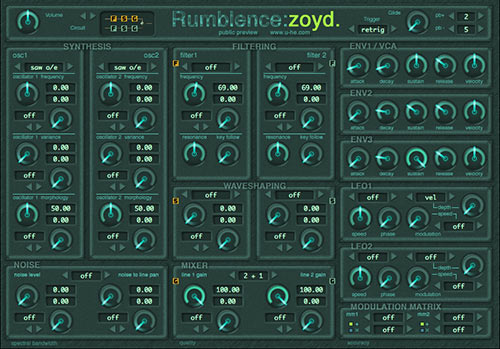
These are not just ordinary oscillators. They sport four parameters: Waveform, Tune, Morphology and Variance.

Tune is obvious: You can tune each oscillator +/- 24 semitones in 100 steps per semitone ( 1/2 cent ). Like most parameters, this one can be modulated by an arbitrary source with depth of 24 semitones.

The other parameters are specific to the waveforms:

Waveform "saw o/e"

This waveform is basically like a common Sawtooth. However, while the fundamental frequency stays untouched, you can tweak the odd and even harmonics in two ways: Variance detunes odd against even which makes chorus-like warm sounds with only one oscillator. But better don't add too much of that or it gets kinda honky tonk. Morphology on the other hand lets you change the volume ratio of odds against even.

Waveform "digiwave"

Though I'm not yet satisfied with this one, I left it in for the friends metallic sounds. It's based on a derivate of Phase Modulation (PM) with four sine modulators and one sine carrier, where Variance determines the depth of modulation and morphology morphs through different ratios of the modulators which btw. ringmodulate each other. As I said, I don't like it very much and it's kinda experimental, but what gives, it's here.

Waveform "pwm"

This is an ordinary pulse wave with adjustable width via Morphology parameter. Variance does nothing. Put an LFO on variance and you have an ordinary synth sound. However, it's fat. - But it's still the least optimized wave with plenty of "no-interpolation noise".


Noise


Is just what it says, nothing extraordinary except that it still is a short wave with audible loop. This section will be modified in future to access side chain input and provide suboscillators, if necessary.

However, you can adjust the volume of the noise and the ratio it is fed to Line 1 vs. Line 2 (lines are part of the modular concept, see "Circuit").

 
Filters


Now that's a funny section. here are the 17 different filter types:

  • lowpass (warm 12db, good for bread'n'butter, but closes quite fast)
  • bandpass (dito)
  • highpass (dito)
  • notch (dito)
  • comb (experimental. modulate moderately! for flanging effects)
  • lowpass2 (straight 24db)
  • tame LP2 (less resonance, more flavour)
  • rude LP2 (monster resonance)
  • bandpass2 (more straight than above version)
  • highpass2 (dito)
  • notch2 (dito)
  • peak2 (huh? where's peak1?)
  • low shelf (makes things fat or thin)
  • highshelf (controls crispness)
  • phaser (7-stage resonant allpass for the funny things)
  • vow f (soft soprano formants morphing a-i-e-o-u)
  • vow m (more vocoder-like bass morphable formants)

All cutoff frequency values correspond to MIDI Note numbers (69 = a) except for comb and vowel filters. Setting Key Follow at maximum maps cutoff frequency exactly to played notes. Adding cutoff transposes accordingly (cutoff = 12 means + 1 octave)

Waveshapers


Okay, there are 4 different waveshapers:

scramble

can do nasty things. Usually steals bass.

engage

Add presence and saturation...

degenerate

bit reduction.

wedge

Does what it says, but results a bit in a low output. Must change that later.

Use the waveshapers to add "dirt" and "xtreme" to your sounds.

 
Mixer and Circuit


Now, here comes the heart of Zoyd.

Zoyd consists of two signal paths (Line 1 and Line 2) that at one point get mixed together.

Line 1 and Line 2 are fed by oscillators 1 and 2 respectively. In addition they optionally get fed by the noise (see above).

The Circuit diagram shows 9 different ways how the modules are assembled and what happens with the 2 lines: There are squares with F (filter), S (shaper) and G (gain) in orange (filter1, shaper1, gain1) and green (filter2, shaper2, gain2). And there's the point where both lines come together.

In addition, the mixer allows for settings "1+2", "1-2", "1x2" (like ringmodulation), "1" and "2".

You see, there's a wide variity of possibilites. play around with that.

 
Modulators


The modulators are quite self explanatory:

  • ADSR1 / VCA
  • ADSR2
  • ADSR3
  • LFO1
  • LFO2
  • MM1 (MM = Modulation Matrix)
  • MM2


in addition, there is MIDI stuff like Velocity, Pressure, Modulation Wheel, Pitch Bend and Glide.

Need more? - Tell me!


u-he - audiounits - rumblence:pure - more feedback machine